

Exhibitions

Janice Nowinski, 2022, Oil on canvas, 27.94 x 35.56 cm

Heidi Hahn, 2019, Oil on canvas, 96.52 x 101.6 cm

Shari Mendelson, 2019, Repurposed plastic, hot glue, resin, acrylic, polymer, mica, 33 x 15 x 18 cm

Shari Mendelson, 2018, Repurposed plastic, hot glue, acrylic polymer, resin, 21.6 x 16.5 x 21.6 cm

Craig Taylor, 2020, Oil on canvas, 25.4 x 20.3 cm

Craig Taylor, 2020, Oil on canvas, 25.4 x 20.3 cm

Shari Mendelson, 2019, Repurposed plastic, hot glue, resin, acrylic, polymer, mica, 34 x 10 x 30.5 cm

Tim Wilson, 2018, Oil on paper mounted on linen stretched panel, 25.4 x 19.1 cm

Tim Wilson, 2019, Oil on paper on panel, 38.1 x 28.6 cm

Tim Wilson, 2019, Oil on paperon panel, 57.2x 42 cm

Shari Mendelson, 2020, Repurposed plastic, hot glue, resin, acrylic, polymer, paint, mica, 23 x 10 x 28 cm

Heidi Hahn, 2023, Oil on canvas, 30 x 23 cm

Harriet Korman, 2019, Oil on canvas, 101.6 x 132.08 cm
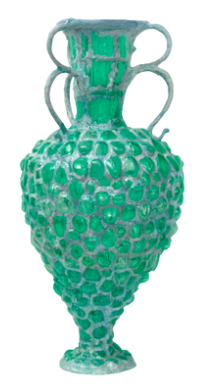
Shari Mendelson, 2016, Repurposed plastic, hot glue, acrylic polymer, resin, paint, mica, glass frit, 74 x 32 x 32 cm
ECHOES OF US
Fahrenheit Madrid presents Echoes of US, an exhibition featuring works by Shari Mendelson, Harriet Korman, Tim Wilson, Heidi Hahn, and Janice Nowinski
Fahrenheit Madrid presents Echoes of US, a group exhibition bringing together six American artists whose works explore the contrasts that shape our relationship with art and identity: the ancient and the contemporary, the intimate and the narrative, the abstract and the figurative, nostalgia and the present.
Shari Mendelson, Harriet Korman, Tim Wilson, Heidi Hahn, and Janice Nowinski approach these questions through distinct visual languages, yet all share an introspective perspective on time, memory, and representation. Through materials, forms, and cultural references, their works function as echoes that intersect across eras, styles, and perceptions.
Shari Mendelson uses discarded plastic to reinterpret forms inspired by archaeological objects and figures. Her sculptures, situated somewhere between false remnants of past civilizations and relics of our consumer-driven present, transform the ephemeral into the eternal and the residual into the sacred.
Harriet Korman develops a pictorial language based on rhythm, color, and repetition. Her abstraction, devoid of direct narrative, conveys humanity, sensitivity, and a radical formal freedom, born from a deep commitment to her own creative process.
Tim Wilson works from cinematic stills that he transforms and distorts. The result is a series of mental landscapes where the collective nostalgia of cinema becomes an unsettling, dreamlike sensation. Each painting becomes an invented memory.
Craig Taylor combines abstraction and portraiture in his series Figments: his canvases begin with recognizable images—heads, busts, legs—which he then transforms into dense chromatic structures. Taylor works in series to explore how color evokes emotion and generates meaning; his palette intensifies the psychological, while his visual references oscillate between the classical and the popular, from landscapes to comics.
Heidi Hahn depicts the female figure through an immersive palette and expressive gestures. Her characters inhabit a self-contained, intimate world, where they seem both present and absent at once. Through this distance from the outside world, the personal becomes universal, and identity emerges as a subtle and emotional territory.
Janice Nowinski works within a dense, restrained, and introspective figurative language. Using oil paint and carefully layered color, she creates compositions that find beauty in the everyday and in imperfect details. Her painting combines the weight of the past with the urgency of the present. Through deliberate brushstrokes and enigmatic scenes, she constructs open-ended narratives where the ordinary acquires symbolic depth.
Taken as a whole, Echoes of US does not propose fixed answers, but rather open resonances: echoes between artists and viewers, between past and present, between art history and its constant reinvention. The exhibition is an invitation to listen to the multiple layers of who we are, who we have been, and who we remember ourselves to be.